Posts

Showing posts with the label #ECE #minfulness #mindful
Image
                                             Since 2013, this little blog has been my space to share ideas, reflections, and encouragement for those just starting out in early childhood education. My focus has always been on supporting new ECEs and students, and weaving mindfulness into the work we do with children. After more than a decade of writing, I feel like I’m all blogged out! While I won’t be posting new material here, the blog will remain available for you to read and revisit anytime. You’re welcome to keep exploring the posts, and you can also find more on my landing pages: Mindfulness in ECE and English for ECEs . I’m still very much involved in the field—I continue to teach ECE and English classes at my local college, and I also do consulting work. It’s been such a joy to connect through this blog, and I’m grateful for everyone who has read along over the y...

WHERE HAVE ALL THE BOARD GAMES GONE?

Image
  Board games teach children how to win and lose gracefully. Board Games used to be and should again be a big part of childhood (and a regular part of family life) as they naturally teach children a wealth of life skills through play. Have they completely lost ground in this digital age to become an endangered species? Monopoly for example, was invented more than a hundred years ago but still teachers a variety of money management concepts to school age children. Players immediately learn that money has a tangible and quantifiable value; it does not come out of a bank machine, or magically from a debit card at will during the game.   Money needs to be treated as a commodity which has to be budgeted and saved. Game players must follow the rules in order to play the game. An important life lesson that is often overlooked; rules have their place and function in life. Whenever possible, create an environment where you can sit and play board games with your children.  ...

MIND MAPPING FOR CHILDREN AND ECES

Image
  WHAT IS MIND MAPPING? A mind map is a visual diagram with information focused on a central idea. It is built around a single central topic. By placing the main idea in the centre, onlookers or readers can easily understand the map's focus and add their own thoughts and connections when viewing the information. Mind maps are a simple, visual method to organize ideas for better clarity and recall, so when the creator returns to the map with new ideas or thoughts for expansion, they can easily remember the focus and purpose of the topic.   MIND MAP FOR MINDFUL EARLY CHILDHOOD EDUCATION SPACES Mind Maps make learning visible. Mind Maps make thinking visible.   Mind maps create a visual map of ideas, concepts, and connections. ·         Mind Maps create relationships between things. ·         Mind Maps are a part of emergent curriculum. ·         Mind Maps are a visualization o...

THE MINDFUL ECE'S PROFESSIONAL DEVELOPMENT WORKBOOK

Image
Time to organize your professional development? Wondering where to start for your CPL? The Mindful ECE answers the call... The Mindful ECE's Professional Development Workbook is a hands on, living documentation for ECEs to develop professional goals, expand their expertise, and record their emerging inspirations into a useful chronicle of their growth.
Image
  SLOW DOWN SCHOOL AGE CHILD CARE Step back and breathe ·        Reduce the noise by slowing down your school age child care day. ·        Streamline activities and routines so they have more time to wander and play. ·        Plan for simple PD days ·        Use more exploration and inquiry ·        Provide more provocations and time for projects ·        Create a variety of journals ·        Show them how to make their own learning stories  Download a free copy

CREATING A BALANCED CHILDHOOD (Fostering spirituality in children)

Image
I’ve often wondered how to teach my children a true sense of spirituality, a way to nurture their inherent spirit, and intrinsic desire to connect with what is good, healthy and ideal in this world?   I’ve heard it said that spirituality is something that develops over time, and that people view somebody who is spiritual as older, wise, stoically connected with nature, God and the universe.   But, when does that connection start?   Birth, puberty, after a life-altering event?   I think children are naturally spiritual, and as a parent I want to foster that inherent spirit into a reliable foundation from which my children can grow and develop.     Where can parents start teaching these grand lessons of life?   As an early childhood educator, I have a healthy respect for structured learning.   Children learn important lessons in school, as well as in formal child care.   Successful learning often happens within the comfort of everyday rou...

GIVE YOURSELF A SOUNDBATH

Image
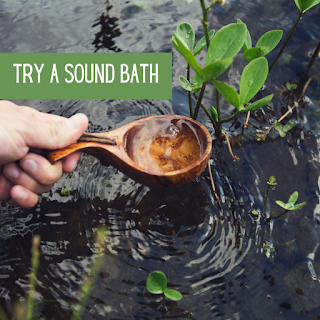
  DECLUTTER YOUR MIND If you want to clear your head of noise, you’ll need to sit quietly and maybe listen to some brain food (concentration music or sounds) A quick internet search will yield a vast array of music streaming. Allow thoughts to filter through your mind.   Don’t stop any of them or let them damn up and clutter your mind.   When you try and stop your thoughts, you lead yourself into mind loops where your thoughts end up on a treadmill, and soon you’re reliving, rethinking, and second guessing the past, present, and even the future. To clear your head, you need to let your thoughts flow in and out until your mind is clear. Think of your mind like a river and your thoughts are water.   Clearing head noise is a watershed where the water flows in and out, leaving calm, peaceful, and a restful stillness behind. WHAT IS A SOUND BATH? A sound bath, according to a Very Well Mind , is a meditative experience where those in attendance are “bathed” in ...

THIS SUMMER BREAK – Take an Analogue Holiday!

Image
  A physical detox is always a good idea for your body's health, but have you considered a digital detox for your mental health? Digital detoxes are on the rise, and people are now going on technology free retreats to cleanse the body and mind with distraction free real life adventures and down time.   THE BENEFITS OF A DIGITAL HOLIDAY? Mind Calm – quiet without any beeping, pinging and ringing notifications.   You mind is free to just experience blissful quiet. Simplicity – Return to reading a hard copy book instead of a screen.   Let your mind wander and day dream.   Have a conversation without distractions and take some memory photos just for yourself and not social media.   A DIGITAL CLEANSE FOR THE WARY Start with a digital staycation: SHIFT FOCUS – now that technology is not within reach, notice how much you've come to depend upon it?   What did you do before you could just pick up your cell phone … to call … search for informa...

CONVERSATION VS TALKING TO YOUNG CHILDREN

Image
  4 Intrinsic Differences Between A Conversation And Talking To Young Children THE DIFFERENCE between “talking to” and “talking at” the child. “Talking to” is being part of the conversation (the back and forth). 'Talking at” is dictating the conversation (very one sided) “Conversing with young children requires mutual engagement and active listening by both parties involved.” CONVERSATIONS need to be at the child's developmental stage.   TALKING is the physical ability to say words, phrases and construct sentences. Conversing requires the ability to talk with the cognitive ability and nuances of exchanging ideas. CONVERSATION is a state where two people exchange ideas, feelings and thoughts. It is the rise, ebb and flow between individuals.   It is an inclusive feeling for everyone involved. When we converse with young children we enter their world. We gain their attention and trust.   We experience their wonder, enthrallment and excitement of their wor...